





Walk into almost any bathroom in the world and you will find the exact same object sitting on the shower ledge: a hard, unyielding block of soap. It has been there for generations, and because it is so familiar, we have been trained to blame ourselves for its mechanical flaws. When a wet bar shoots out of your hands and bangs against the shower floor, you assume your grip was clumsy. When a rigid edge bridges awkwardly across a shoulder, calf, or ankle, making contact with only a tiny strip of skin at a time, the inefficiency barely registers. We simply scrub harder, turn the bar at a strange angle, and accept the friction as the baseline cost of getting clean.
At SANSNiKTM, our foundational rule is to look closely at everyday friction and ask a simple question: must it be like this? When you strip away centuries of habit and look at a traditional bar of soap as a piece of physical engineering, a glaring truth emerges. Traditional soap is not a rock-hard brick because a rigid block is the best way to wash a curved human body. It is a rock-hard brick because that is what a nineteenth-century factory conveyor belt required. The form factor was designed for automated stamping presses, wooden shipping crates, and grocery store shelves. It was never designed for your hands, your skin, or your shower.
How We Got Stuck With the Brick
For the vast majority of human history, soap was never a hard rectangle. When ancient Mesopotamians boiled plant oils with wood ash nearly five thousand years ago, the resulting cleanser was a soft, scoopable paste stored in clay cylinders. For millennia across the Mediterranean and the Middle East, cleansing compounds remained semi-solid salves, oils, and pliable pastes that yielded immediately to the warmth and pressure of the hand.
The Industrial Revolution erased that tactile history in a matter of decades. As soapmaking transitioned from regional craft vats to high-volume chemical factories, manufacturers needed a material that could survive mechanization. On the SANSNiKTM Flexibility Scale, the industry locked itself entirely into F10, the rigid extreme of solid matter.
Molten sodium soap was poured into massive cooling frames to solidify into monumental blocks, which were then pushed through wire-cutting harps to slice uniform rectangular slabs. Those slabs had to be hard enough to endure high-speed mechanical dies that stamped brand names into their faces without sticking to the metal mold. Once stamped, rectangular bricks could be stacked tightly inside wooden freight crates with zero wasted air, capable of bearing the crushing weight of pallets stacked twenty feet high in a warehouse without deforming. By the time that brick reached a retail shelf, it was an industrial triumph of logistics and packaging density. In the shower, however, it remained an uncompromising block of salt and tallow.
The Liquid Overcorrection
By the late twentieth century, consumers had finally grown tired of the compromises baked into traditional F10 soap. Nobody enjoyed scraping chalky soap scum off glass shower doors, cleaning out a slimy soap dish where waterlogged bars turned to mush, or trying to lather up with a dried-out, cracked sliver at the end of a bar's life.
Yet when the personal care industry responded, it did not fix the bar. Instead, it abandoned solid chemistry altogether and swung to the opposite mechanical extreme: F0, pure liquid body wash.
Trading F10 for F0 solved the slimy soap dish, but it introduced an entirely new set of daily frustrations and environmental inefficiencies. A pourable liquid has zero structural tension, meaning half of every pump slips straight between your fingers and washes down the drain before it ever reaches your skin. To make up for that lost traction, the industry introduced plastic mesh poufs that trap bacteria, alongside heavy single-use plastic jugs equipped with pumps that clog and crack. Worst of all, liquid body wash turned the global supply chain into a water-shipping operation, filling freight trucks with heavy plastic bottles composed of up to eighty percent water. We traded a brick that fought our hands for a liquid that could not stay in them.
Flipping the Physics of the Shower
When we started developing SANSNiKTM, we knew the solid bar did not need to be abandoned. It needed to evolve. The ambition was to keep the concentrated, plastic-free efficiency of a solid cleanser while completely rewriting its physical relationship with the human body.
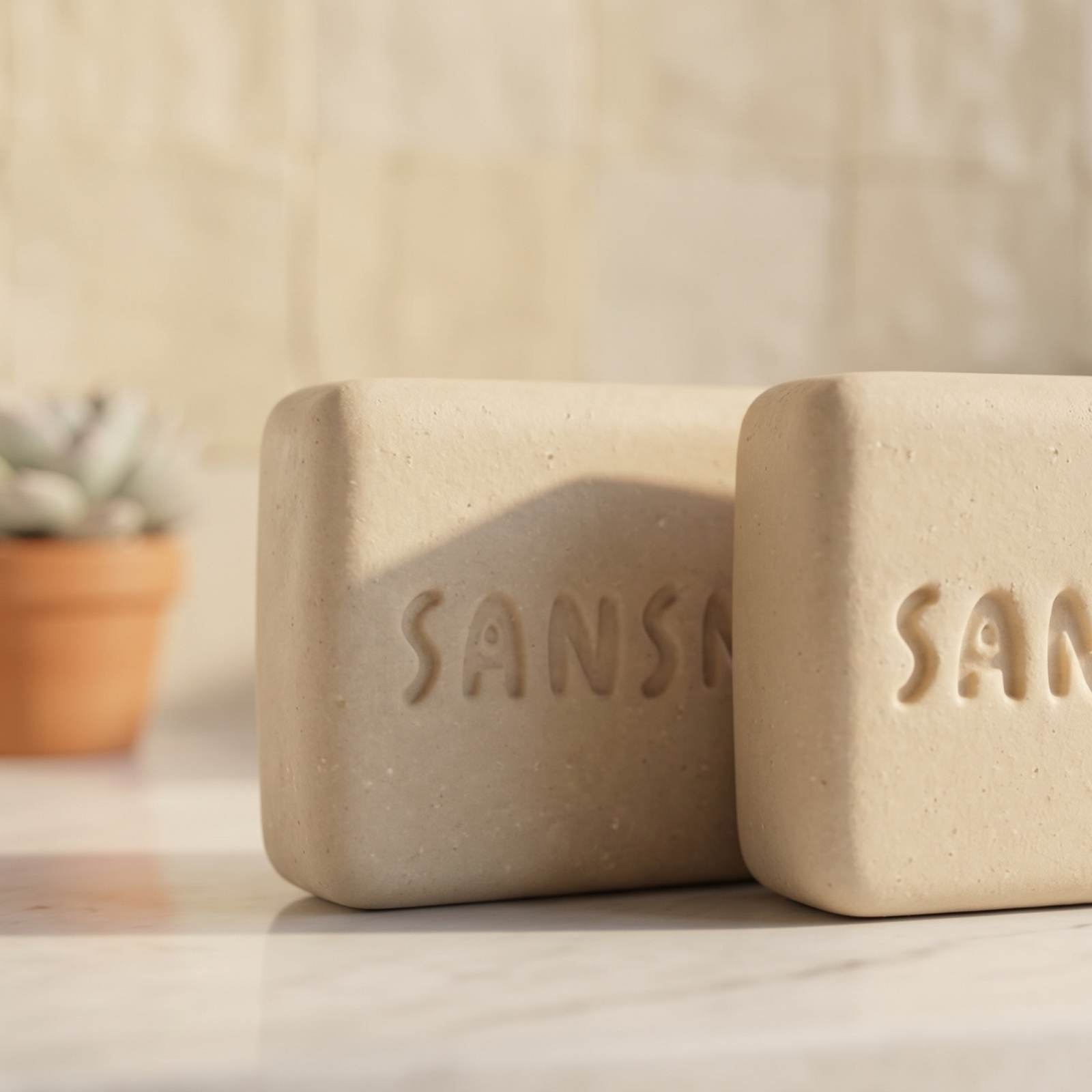
The result of that two-year engineering effort is The Contour BarTM, calibrated to an exact F5 on our Flexibility Scale. Measuring 3.5 inches long, 2.5 inches wide, and a full 1.0 inch deep, it sits on the shower ledge looking like a clean, architectural solid. The moment you pick it up under warm water, the F5 calibration flips the physics of the shower in three fundamental ways:
- Geometry that bends to yours. The human body has no flat planes. Under ordinary washing pressure, the core of an F5 bar arcs smoothly along its length, wrapping around shoulders, calves, Achilles tendons, and ankles. Instead of a rigid edge scraping across a high point, the entire face of the bar maintains flush, cushioned contact with your skin.
- A grip that holds back. A rigid soap bar acts like a wet ice cube because water forms a slick hydroplane barrier over an unyielding surface. At F5, the outer surface of The Contour BarTM offers subtle micro-yield. Your thumb and fingertips press slightly into the face of the bar, creating natural mechanical traction that settles securely into your palm even at peak lather.
- Impact absorption. Everyone drops a bar of soap eventually. When a traditional six-ounce brick falls from chest height, it hits with enough concentrated force to bruise a foot, chip a ceramic tile, or dent its own corner into a jagged edge. Our flexible matrix acts as a natural shock absorber, taking the kinetic hit internally and bouncing softly without damage to you, your shower, or the bar itself.
Both The Contour BarTM (Smooth) and The Contour BarTM With Grit are engineered to this identical F5 standard. Smooth is built as a daily full-body bar, and is not for the face. With Grit suspends fine volcanic pumice inside the flexible matrix to scrub below the neck, the hands, and the feet, and is also not for the face.
Engineered Out of Every Bad Habit
Changing the mechanical feel of a bar meant nothing if it still behaved like traditional soap between showers. To make F5 viable for everyday life, we had to engineer every historical bad habit out of the solid format from the ground up.
Because The Contour BarTM uses a balanced, skin-friendly surfactant and hydrocolloid system rather than traditional saponified fats, it leaves zero chalky soap scum on shower glass or tile. Its internal structure is hydro-stable, meaning water activates a dense, creamy lather on the surface without soaking into the core. Even if the bar is left sitting in a wet dish, it will not dissolve into a gelatinous puddle or swell into a soggy sponge.
That structural lock completely changes how a solid bar travels and wears down. If you are packing for the gym or a weekend trip, you do not need to wait hours for the bar to dry or carry a bulky, slotted draining case. You simply finish your shower, pat the bar dry with a towel, and drop it straight into your travel kit. Back home, that same structural integrity ensures the bar keeps its exact F5 flex from the very first wash to wash thirty and beyond, wearing down evenly without ever drying out, cracking, or snapping into brittle slivers. And because the matrix is thermally locked up to 170°F, it can leave our US manufacturing facility in the dead of summer, ride inside a scorching freight truck, and arrive at your door in the exact condition it left our curing racks, wrapped entirely in plastic-free packaging.
This article is the industry and history behind flexible cleansing. For SANSNiKTM’s own journey building The Contour BarTM — the two-year pursuit and the standards locked into F5 — read The Story of The Contour Bar.